Code of Ethics
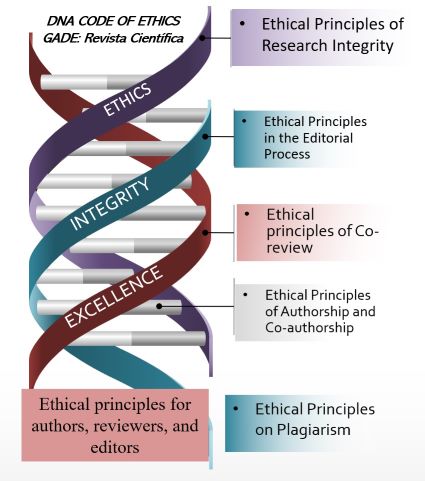
GADE: Scientific Journal is committed to promoting integrity, transparency, and excellence in the publication and dissemination of scientific knowledge. Our code of ethics establishes the standards and principles that govern the behavior of all involved in the editorial process, including authors, reviewers, editors, and the editorial team. The aim of this code is to ensure the quality and credibility of published content and foster a culture of integrity and respect in our scientific field.
-
Honesty and Originality: a. Authors must ensure that the submitted works are original and have not been published previously or are under consideration for publication elsewhere. b. Authors must properly credit and cite the sources used, avoiding plagiarism in all its forms.
-
Conflict of Interest: a. Authors must disclose any conflicts of interest that may influence the results, interpretations, or conclusions presented in their work. b. Reviewers and editors must abstain from evaluating or making editorial decisions on works in which they have a conflict of interest.
-
Respect and Confidentiality: a. Reviewers and editors must treat works and communications with authors confidentially and respectfully, avoiding any form of discrimination or bias. b. Reviewers and editors must not disclose information about the works under review, except in exceptional situations and with the express consent of the authors.
-
Rigor and Objectivity: a. Reviewers and editors must evaluate works impartially, based on scientific and methodological quality, and provide constructive and well-founded feedback. b. Authors must present their results clearly, accurately, and honestly, without distorting data to favor biased conclusions.
-
Review Process: a. Reviewers and editors must carry out the review process transparently and efficiently, clearly communicating decisions and feedback to authors. b. Authors must actively participate in the review process, responding to comments and making necessary modifications to improve the quality of the work.
-
Retraction and Corrections: a. Authors must promptly inform the editors if they discover significant errors in their published work and cooperate in timely correction or retraction. b. Editors may take appropriate action in cases of scientific misconduct, such as retracting articles if fraud, plagiarism, or serious violations of the code of ethics are detected.
-
Transparency in Funding and Support: a. Authors must disclose all sources of funding and support that have contributed to the work. b. Editors must disclose any funding or support that may influence the editorial process.
-
Respect for Copyright Policies: a. Authors must comply with the journal's copyright policies and obtain necessary permissions for the use of copyrighted materials in their work.
- Transparency in writing: All actors involved in the editorial process (authors, reviewers and editors) must act with honesty, transparency and responsibility.
- Impartiality: Editorial decisions will be based solely on the validity, importance, originality and clarity of the manuscripts, without discrimination based on race, gender, sexual orientation, religion, ethnic origin, nationality or political ideology of the authors.
By adhering to this code of ethics, GADE: Scientific Journal seeks to foster a community of responsible research and commitment to scientific excellence. All involved in the editorial process must be aware of and respect these principles to maintain the integrity and quality of our scientific publication.
Please note that plagiarism is a serious breach of publication ethics and is strictly prohibited. Any use of another person's ideas, words, images, or any other material without due acknowledgement is considered plagiarism. This includes:
Direct plagiarism: Copying text word for word without attribution.
Inappropriate paraphrasing: Rephrasing another person's text without significantly changing the original structure or meaning and without citing the source.
Plagiarism of sources: Presenting another person's work as one's own.
Self-plagiarism (or plagiarism of oneself): Reusing substantial sections of one's own previously published work without proper reference or justification, or submitting the same manuscript to multiple journals simultaneously.
The use of generative AI (such as ChatGPT, Bard, among others) in manuscript preparation must be declared and limited. If the authors have used generative AI tools for writing, data analysis, or any other part of the manuscript, they must explicitly state which tools were used and how they were used in the "Materials and Methods" section or in a dedicated section at the end of the manuscript, prior to the references. AI tools should not be used to generate original research ideas or fabricate results. Generative AI cannot be listed as an author. Authors are solely responsible for the content, originality, and accuracy of their manuscripts, even if they have used AI tools. It is imperative that authors review and correct any AI-generated text to ensure its accuracy and compliance with ethical standards.
GADE: Revista Científica accepts and subscribes to the principles of the Committee on Publication Ethics (COPE) (https://publicationethics.org/core-practices), a non-profit organization whose objective is to support researchers in achieving ethical, integral, and responsible publication. The complete code should be consulted [here].